
In the heart of San Bernardino, California, where green spaces are a cherished rarity in the urban desert landscape, a new kind of sanctuary has taken root. The Frances Grice Cardinal Child Development Center (CCDC) is a landmark achievement for the San Bernardino City Unified School District (SBCUSD), serving as a visible example of what happens when a community’s vision for its youngest learners meets architectural innovation and intentional design that is rooted in place.
Project Profile: Frances Grice Cardinal Child Development Center

How Intentional Design and Real Collaboration Created a Living Sanctuary for San Bernardino's Youngest Learners
Written by Insiya Rasiwala | Photography by Jason O'Rear
Read the full story below.
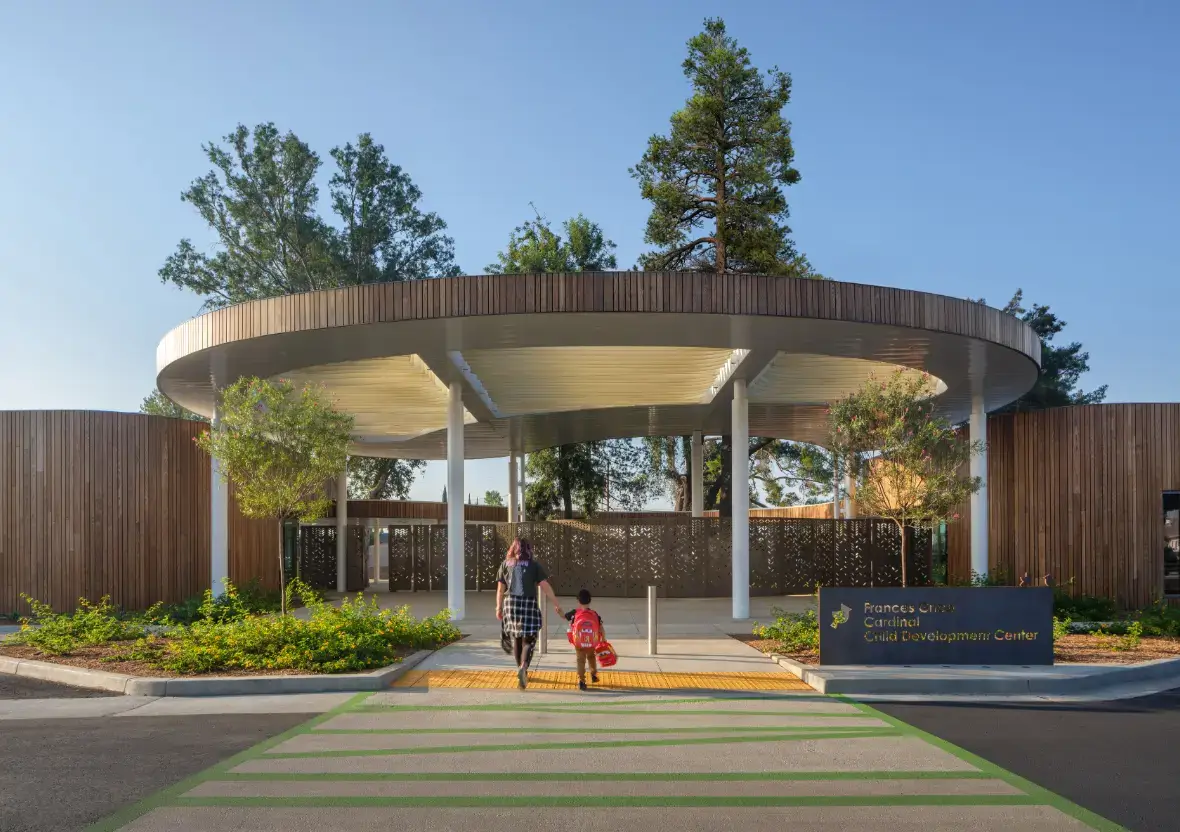
Warm wood, soft flowing curves, and natural elements welcome learners and their families to each new day.
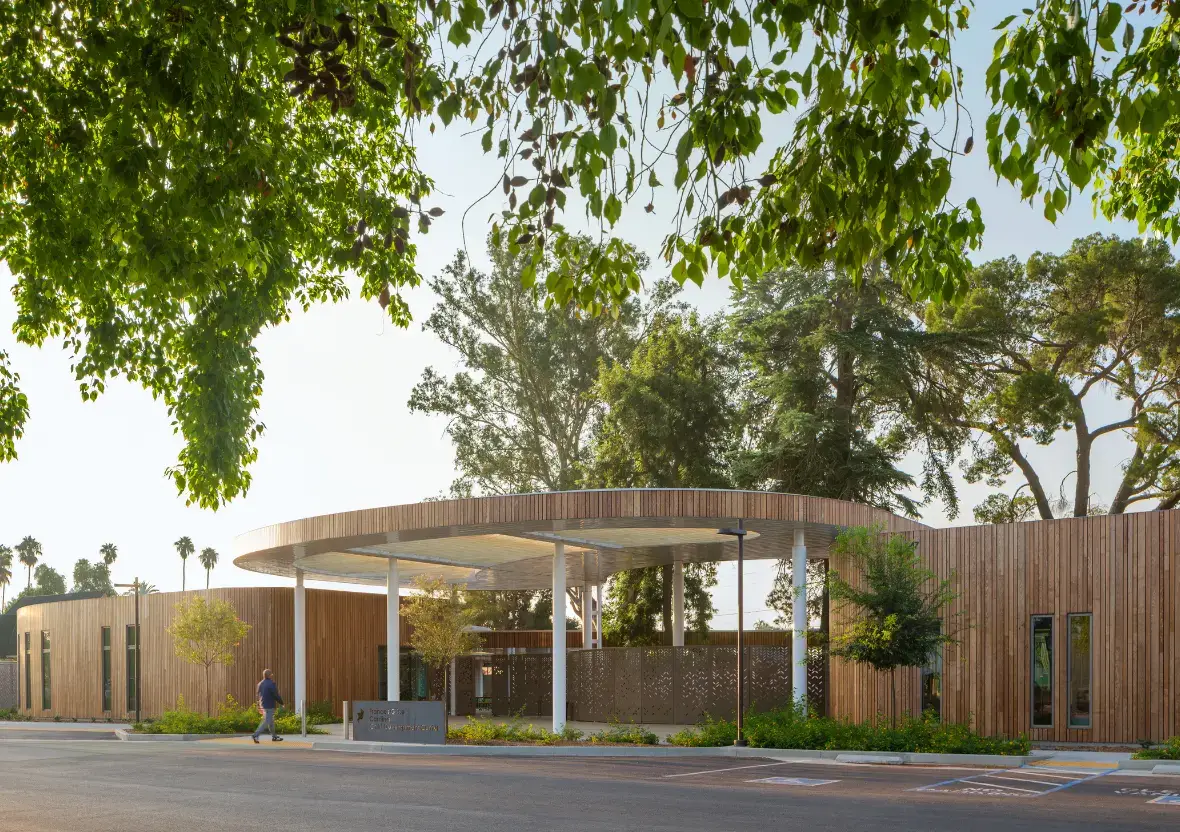
Natural materials and modern architecture blend seamlessly as the building’s unique profile sits nestled behind a canopy of trees.
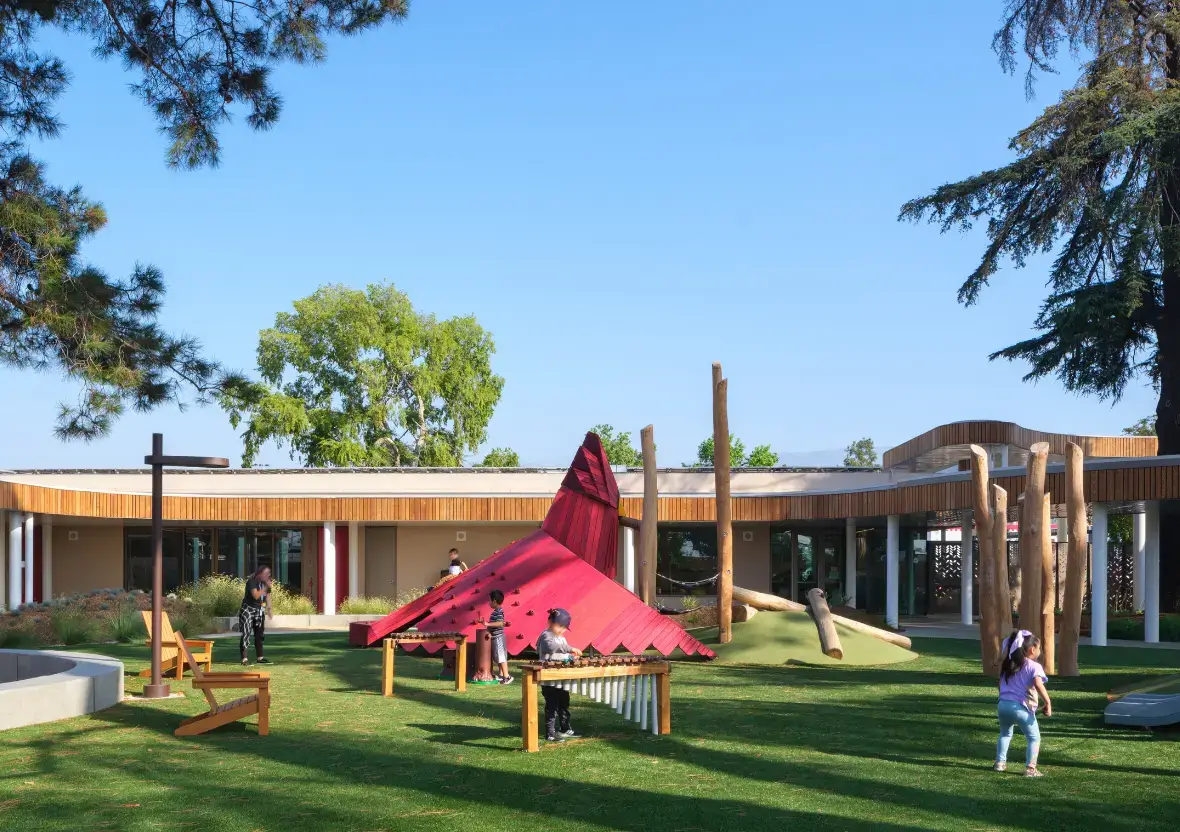
A vibrant cardinal red bird-shaped structure is the centerpiece of a sunny, grassy play area where children actively climb and explore.
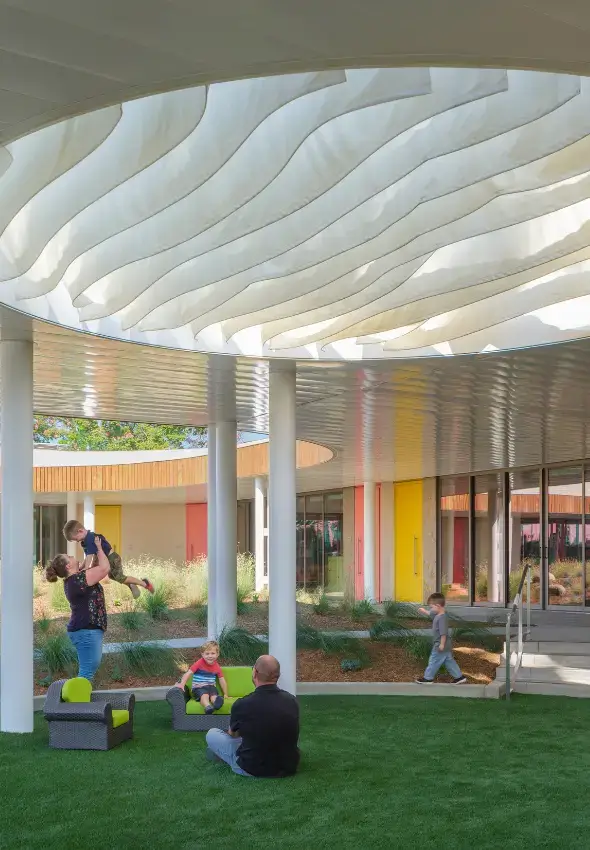
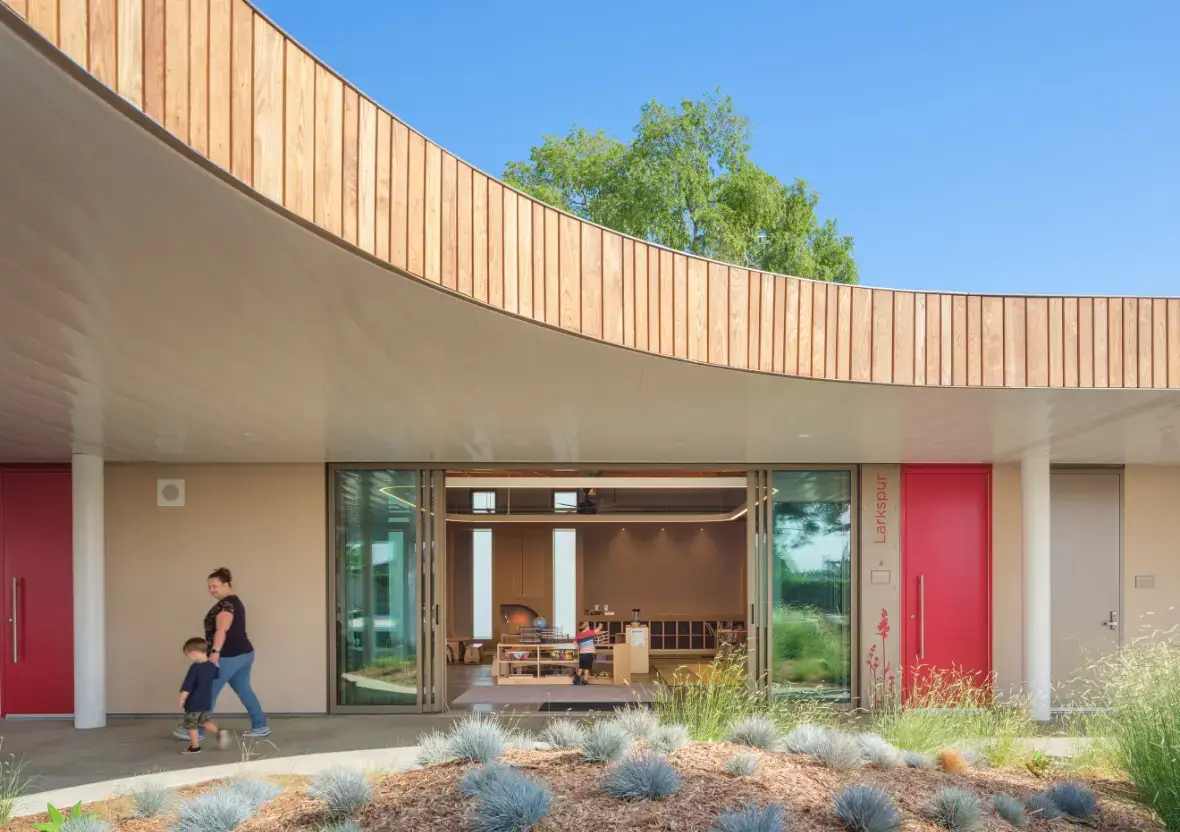
The curved wooden roofline shelters the transition between the bright, open learning space with Evergreen™ Shelving and the landscape outside.
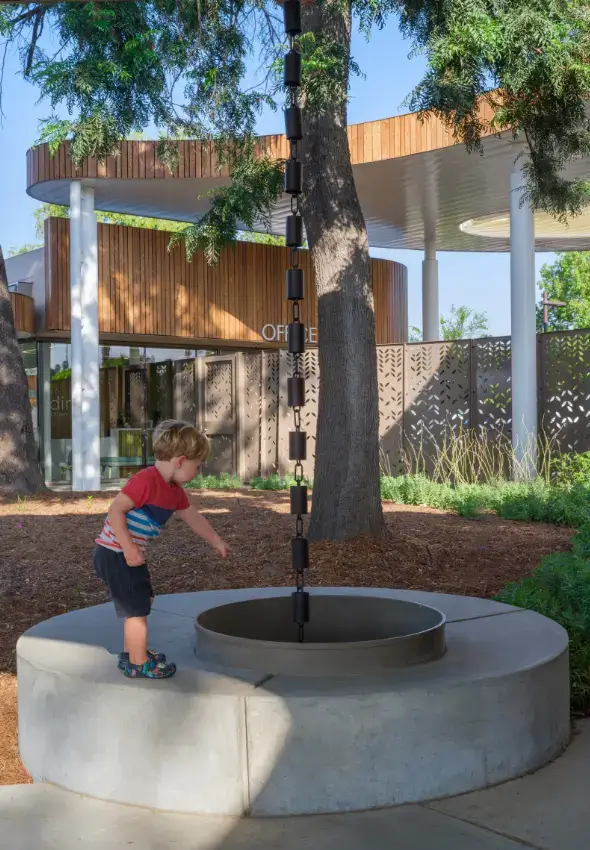
A child curiously points to the metal rain chain hanging over a concrete basin.
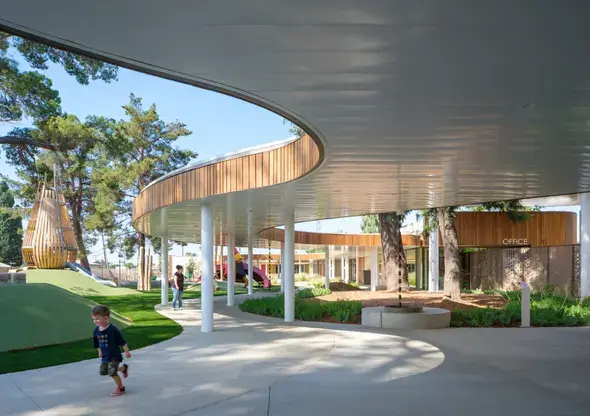
A rhythmic, wood-trimmed architectural canopy curves through the outdoor play area, providing shade and visual movement.
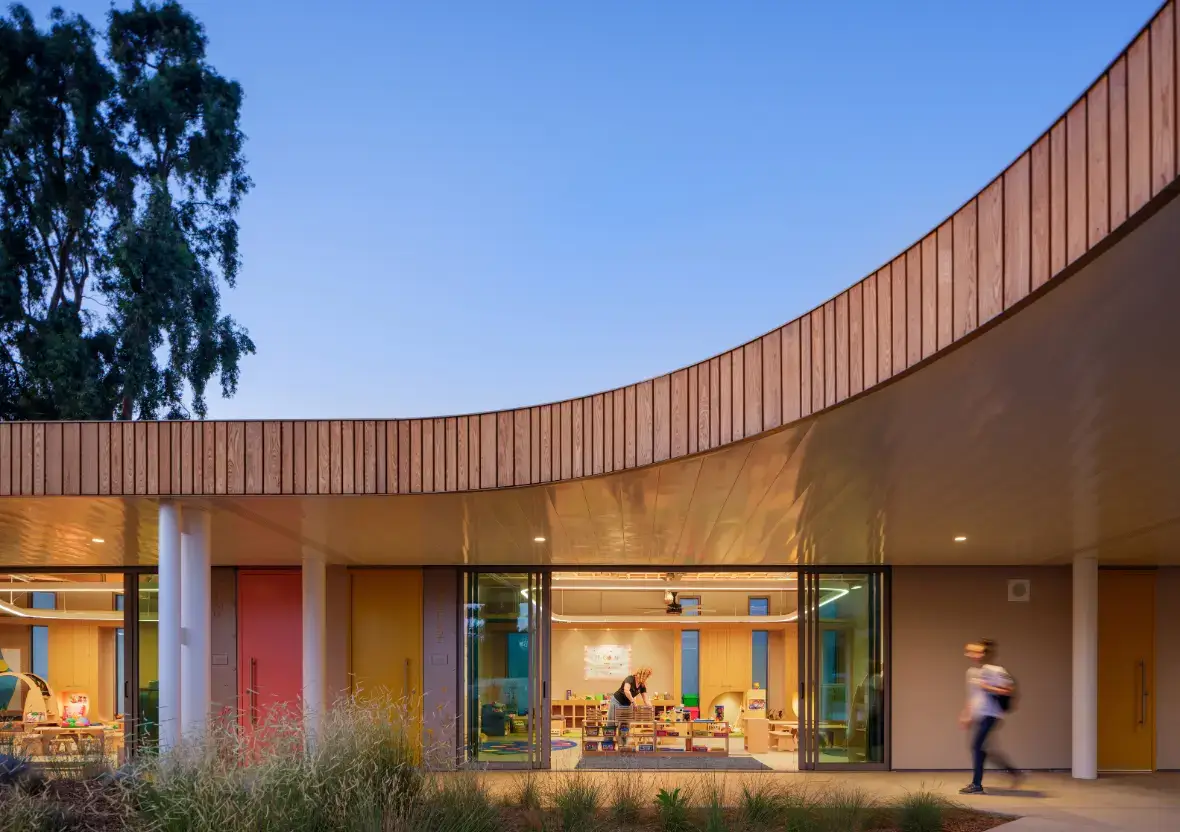
Against a deepening blue sky, the building’s organic curves and glass facades glow with inviting warmth from the interior spaces.
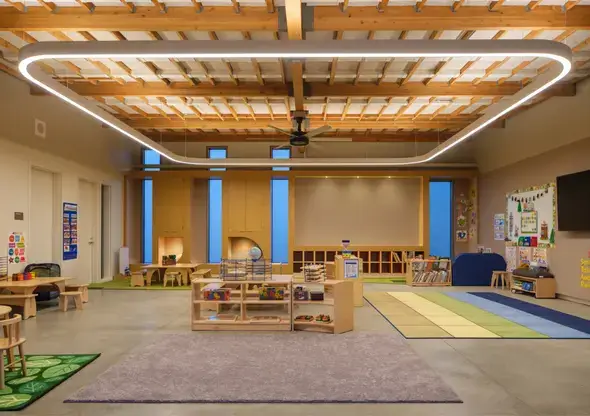
A geometric overhead light anchors the spacious room, which is filled with Evergreen™ Shelving, a Reach™ Table, Unity™ Stools, and Share™ Benches.
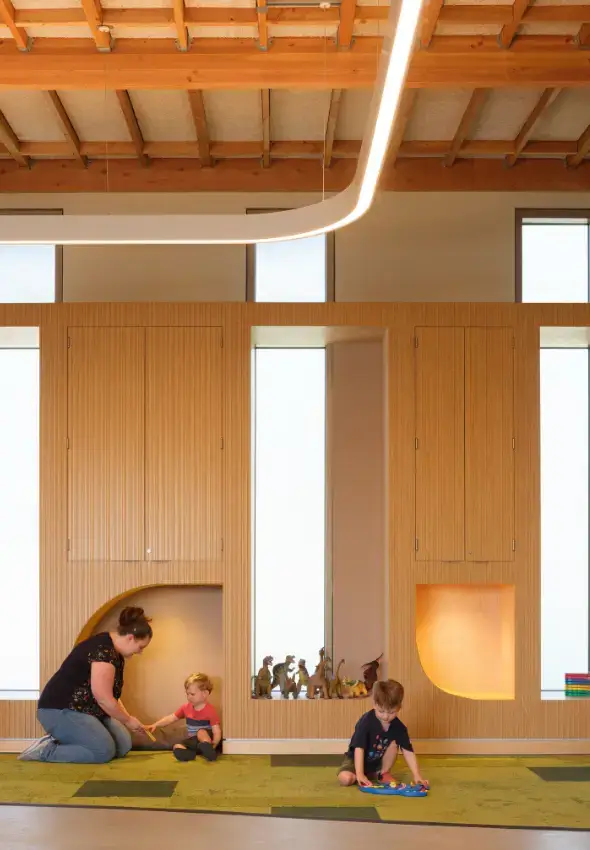
Wooden cabinetry includes cozy, illuminated curved cutouts designed to create a calm and inviting space.
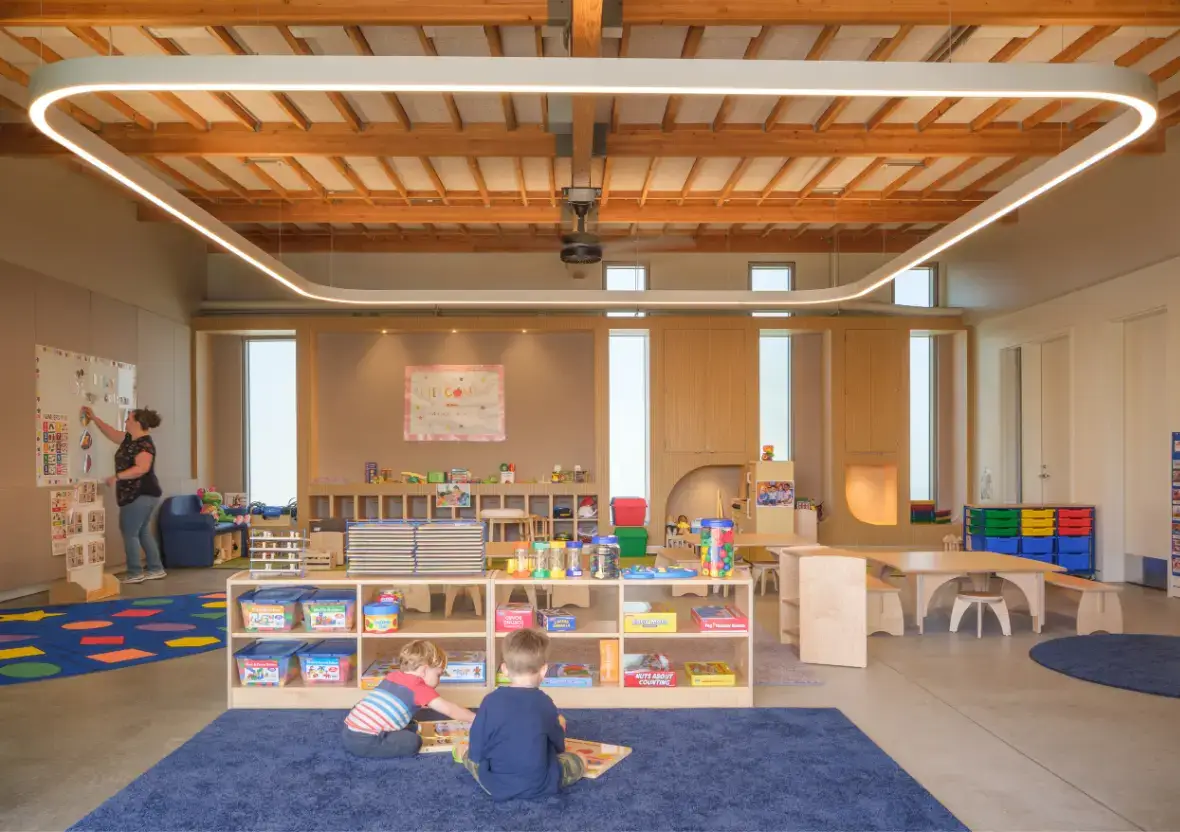
The warm wood and soft edges of Natural Pod’s Reach™ Tables, Share™ Benches, and Evergreen™ Shelving perfectly complement the open-ended learning space.
A LEED Platinum certified and Net Zero designed facility, the center is a beacon of sustainability and social equity. It provides a world-class environment for a diverse, traditionally underserved community, proving that high-performance environmental design and nurturing early childhood education are deeply interconnected. The project is also a study in harmonious, collaborative partnership. Here, the goals of a forward-thinking school district are translated in the organic forms of award-winning architecture firm LPA’s visionary structures, while within the center’s walls, Natural Pod’s flexible, nature-inspired furniture becomes a true partner in the learning journey.
Designing Around What Already Grows
The inception of the Cardinal project was defined by a commitment to the land itself. The site, once an agricultural plot for a nearby high school, held the “gift” of dozens of mature trees. While typical development might see such features as obstacles, the team at LPA and the SBCUSD viewed them as the project’s primary inspiration.
Shae Foster, LPA’s Senior Project Architect, remembers the project’s beginnings as a moment of values alignment.
This project is a really special one and it’s near and dear to my heart. San Bernardino City Unified came to the table with a vision focused on nature. They wanted to meet the California requirements for TK and pre-K in a truly intentional way. This site in particular became the kickoff point. It was full of mature trees that were really special. That alignment with the client and the desire to save those trees was a huge catalyst for the design.
—Shae Foster
These trees—a collection of cedars, eucalyptus, and Chinese evergreen elms—offer a vital microclimate. The building canopy was designed to mimic and blend with the natural tree canopy, shading the majority of the site. This natural cooling system is so effective that even in the 95-degree heat of a San Bernardino August, the classrooms can remain comfortable without the constant use of air conditioning.
Kenya Huezo, LPA Landscape Architect, describes the preservation effort as an integral part of the site’s success:
It’s every landscape architect’s dream and we rarely get that. To have that be such a huge design driver from the inception—to successfully protect over 20 mature trees and ensure they remain healthy—is a core part of the site experience.
—Kenya Huezo
Trees as Inspiration
LPA’s design team embraced the metaphor of a tree to ground the project’s architecture. The design weaves this concept throughout: the site forms the roots, giving an organic feel to the layout; the building and classrooms represent the trunk; and the generous overhangs replicate a sheltering canopy. Victoria Lowell, Project Manager in K-12 who served as lead interior designer, explains that visitors can walk along shaded walkways that mirror “the experience of being under a forest canopy.”
This metaphor extends to the materiality of the center. Shae notes that the building is clad in wood, with the structure itself remaining exposed to view. This creates a tactile, honest environment where children can see the “bones” of their school. The result is a natural feeling with lots of tactile materials both inside the classrooms and out, designed to spark curiosity and help students begin to understand their world through the built environment.
A central tenet of the design was the shift in perspective to the child’s level. Victoria explains that for once, adults are the ones who have to conform to the scale. The team conducted studies on the different scales of users, from infants to five-year-olds, examining how spaces respond to each age group
Have a Project or Need More Information?
If you need help getting started, please contact us or check out our portfolio!
The Play Wall and the Geometry of Risky Play
The interior of the building features a unique “Play Wall” which the team referred to as the “bark” of the tree. This perimeter structure is designed to be lived in—a place where, metaphorically, squirrels can make nests and birds can burrow. It’s designed at a scale where a two-year-old can crawl into one of these little burrows on the ground, while a five-year-old can use the same space to sit and read a book. The wall responds to all ages simultaneously.
The Play Wall also serves as a primary site for “risky play”—a vital concept in early childhood development that encourages children to test their physical limits and build confidence.
Part of our approach was giving children the ability to take risks safely. We have parts of the play wall that you can climb on, with soft carpet beneath it. We want to encourage that exploration and discovery, which is so important at this age range.
—Victoria Lowell
Navigating Complexity: The 0–5 Journey
Designing for a range of ages from infancy through five years old requires a delicate balance of safety and continuity. State mandates require physical separation between infants/toddlers and the older preschool children. Kenya and the landscape team addressed this by creating specialized zones that still felt part of a singular, cohesive narrative.
The infant-toddler playground is contained, but it is designed as its own experience. The equipment is selected for that specific age group while maintaining flexibility for interpretation. Kenya explains that the team made seat walls shorter—12 to 14 inches—making them accessible for small bodies. The goal was to make the environment non-prescriptive, even for the youngest students.
This non-prescriptive approach ensures that the “Third Teacher”—the environment—is always offering something new to discover, regardless of the child’s developmental stage.
The Synergy of Static and Fluid: Architecture Meets Natural Pod
In a space where the architecture is so deeply rooted in nature, the choice of furniture becomes a critical extension of the design intent. Natural Pod furniture was selected to act as the fluid partner to LPA’s architectural container. While the building provides a beautiful, permanent home for learners, the furniture offers the movement and adaptability required for an inquiry-based curriculum.
The furniture ties into what we were trying to achieve with the architecture. Architecture is static; the furniture adds that piece that makes those ideas fluid. Natural Pod furniture is flexible and flippable. You can change your environment and change how you play and learn with it. Taking a table and flipping it upside down—now it’s a boat or a stage. That adds the movement that educators’ ideas need.
—Victoria Lowell
By choosing pieces that are multi-functional and open-ended, the district adhered to a “less is more” philosophy. This approach reduces clutter and creates a sense of calm, allowing the children’s own work and discovery to be the primary focus.
Shae adds that this flexibility directly empowers the educators. You can go on site and see that each classroom is set up differently. Teachers can choose how to activate that space and create those opportunities for the kids. It’s about choice and opportunity, helping each individual student find the best way to engage.
Supporting the Educator's Evolution
The transition to such a unique, nature-based environment often requires a shift in the way educators interact with their space. Many teachers arrive from traditional classrooms characterized by plastic furniture and fixed layouts. To support this transition, Natural Pod and LPA conducted workshops to help teachers leverage the site’s potential.
Victoria recalls the receptive nature of the staff, noting that the teachers came from very different environments and initially didn’t know how to react to this one. The workshop empowered them to leverage the site—how to go out and pick up a pinecone or twigs and bring those natural elements into the classroom to replace plastic.
A Civic Moment Rooted in Collaboration
The Cardinal Child Development Center is a “civic moment” for San Bernardino. It is a space that belongs to the community, featuring multipurpose rooms that are accessible after school hours for local meetings and youth organizations. This sense of ownership and pride is the result of a high-trust, collaborative process.
Shae emphasizes that the project’s success is a testament to the power of partnership: “I don’t think you achieve these results without strong collaboration. That’s within LPA, with our partners like Natural Pod, and with the district. That’s the magic of this project and how we were able to achieve what we did here.”
Victoria agrees, noting the district’s role in challenging the design team to go further: “I enjoy projects that push the boundaries. This district was relentless with making sure we pushed the boundaries at every turn. They were never okay with the status quo, and we were never okay with the status quo. That is the type of partner you hope to continue to have long term.”
The Personal Impact of Intentional Design
For the architects and designers involved, the CCDC matters professionally, but it also holds personal meaning.
I went on maternity leave after this project was approved and came back to help with construction. My ‘Cardinal baby’ is now going on three. I got to bring my boys out to the site and see them engage with the spaces, the furniture, and the play structures. We are designing these spaces for these little humans to explore and grow, and getting to see my own kids experience that was a magical, full-circle moment.
—Shae Foster
A Path Forward
The Cardinal Child Development Center proves that even in an urban center, nature can take center stage. Through the preservation of mature trees, the use of tactile, sustainable materials, and the integration of flexible, open-ended furniture, the center offers a sanctuary of calm and inspiration.
It stands as a blueprint for the future of early childhood education—a space that respects the agency of the child, the wisdom of the educator, and the resilience of the natural world. At the heart of this project is a simple, powerful truth: when we design for the smallest among us with the greatest of intentions, we create a better world for everyone.

Get your copy of our Ideabook.
Download our Ideabook to find an elegant collection of beautiful, durable, sustainably made furniture solutions for early learning, elementary, middle and high school furniture, as well as library and common spaces. Let’s create exceptional learning environments together. Fill out the form below to get your copy.