How Intentional Learning Environments Communicate Values, Support Communities, and Shape Futures
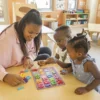
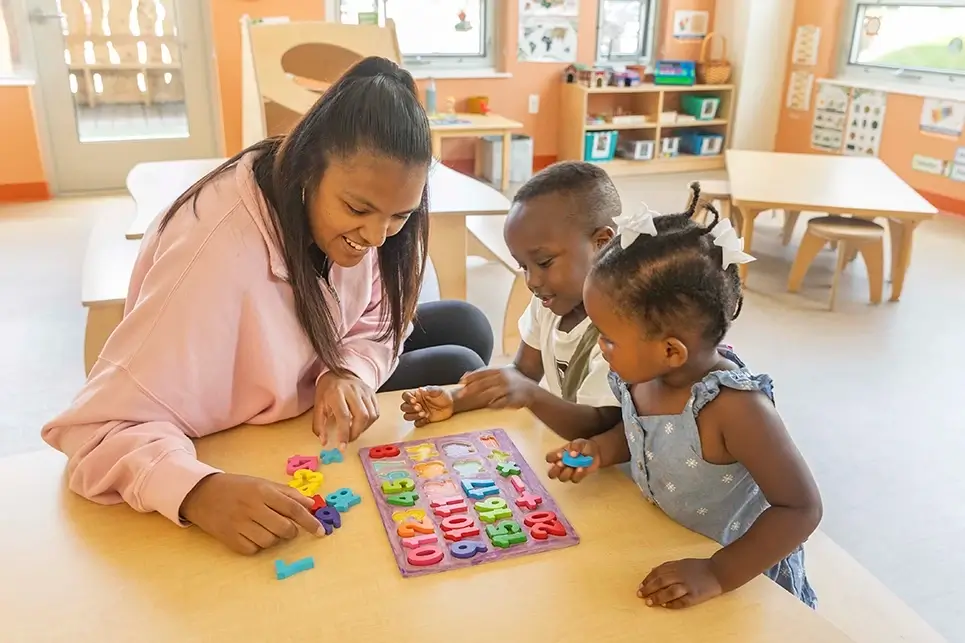
When you walk into a learning space, what does it say to the children who spend their days there? Does it communicate respect for their competence? Does it invite exploration and tell them their ideas are valued? Does it allow learners and educators to feel connected to the space?
As Natural Pod’s CEO Bridgitte Alomes reflects:
“Holistic design communicates values. The environment speaks to the children and their needs. A thoughtfully arranged space communicates respect for the child’s competence, invites play exploration, and tells them, ‘Your ideas are valued here.’” —Bridgitte Alomes, CEO + Founder
This is why holistic design matters—and it’s the lens through which we view every project, every collaboration, and every learning environment we help create. As we reflect on 2025, we’re sharing what we’ve learned about intentional and holistic design and its tangible impact in communities, classrooms, and children’s lives.
Design as Community Infrastructure
Certain projects illuminate the reciprocal relationship between thoughtful environments and thriving communities. This year, two collaborations in particular demonstrated how design decisions ripple outward, creating impact far beyond classroom walls.
Kipohtakaw Education Centre, an Indigenous-focused learning environment in Alberta, Canada, exemplifies what becomes possible when multiple stakeholders unite around a shared vision—creating a trauma-informed learning space where biophilic (nature-inspired) design that favors natural wood and abundant daylight becomes an act of cultural affirmation and healing.
At Boston Square Early Learning Center in Grand Rapids, Michigan, United States—a purpose built nonprofit center for immigrant children has emerged as the heart of its community, Rick Raleigh, Senior Project Manager at IFF, the project’s lender, articulated what often remains unspoken about early learning environments:
“Access to childcare is a major differentiation between folks who can work and support their families and those who can’t because they don’t have access to care. It’s a workforce issue. It’s an economic issue. If we can take care of these children, that means that families can take care of themselves. They can be in the workforce and contribute economically. Studies estimate that every dollar invested in childcare yields a return of $7 to $13 in long-term economic benefits.” —Rick Raleigh, Senior Project Manager, IFF
This is holistic design in its fullest expression—environments that advance pedagogical goals while supporting community resilience and economic equity.

The Disconnect That Drives Us
Sometimes the most powerful insights come from recognizing what’s missing. This year, Sara Sutherland from Capilano University’s Fulmer Family Centre for Childhood Studies named something educators intuitively feel:
“How do you talk about sustainability and climate change in the classroom, and then walk into a setting filled with mass-produced, disposable furniture? It creates a disconnect where students are learning one thing conceptually, but seeing something entirely different in practice.“ —Sara Sutherland, Director of children’s centres, Fulmer Family Centre for Childhood Studies
This observation captures what fuels our work at Natural Pod—the desire to eliminate that disconnect. When your furniture reflects your values around sustainability, when your classroom design supports the pedagogies you teach, when your environment practices what you preach, children receive a coherent message about what matters.
“The Fulmer Family Centre for Childhood Studies project demonstrates this alignment beautifully, embracing a ‘less is more’ philosophy that brings the outdoors in and proves sustainable design enhances rather than compromises learning experiences.” —Cole Kapler, Marketing Project Lead, Natural Pod
Storytelling as Strategy
One of our most significant evolutions this year was learning to articulate why our approach matters. Working with partners and developing new resources, we’ve gotten clearer about communicating how play-based learning environments support future success.
As Natural Pod’s President Marianne Hoonakker-Kelly explains:
“When we successfully share via story and visuals how our product enhances learning to build skill sets and capabilities that will support future success in middle school, high school, and beyond, we know we are helping educators and stakeholders understand the benefits of evolutionary learning spaces. We don’t know what tomorrow will look like, but we know the skill sets our kids are going to need to successfully navigate it.” —Marianne Hoonakker-Kelly, President, Natural Pod

From Challenges to Solutions
Real holistic design means meeting clients where they are, with whatever constraints they face. The Barn Early Learning Center in Washington state presented exactly this kind of challenge: four preschool classrooms operating in a gymnasium, requiring weekly conversion to storage to support weekend community athletic activities.
Rather than defaulting to “that’s too complex,” the team developed creative solutions honoring the school’s educational philosophy while solving their spatial puzzle.
“It was amazing to see relationships we have worked hard to build over the years pay off in such a meaningful way.” —Kelly Rosensweet, Learning + Development, Natural Pod
The school opens in early 2026—a testament to what’s possible when a collaborative design process allows for the needs of multiple community stakeholders.
Elevating the Conversation
Behind the scenes, significant work has gone into how Natural Pod shows up in the world.
“While we have worked hard to become known as a brand that lives at the intersection of sustainability, pedagogy, and design excellence, we have done this by leaning into our authenticity and inclusivity, and by sharing our values and passion to educate our community, not to sell.” —Insiya Rasiwala, Marketing Manager, Natural Pod

Scale Doesn’t Determine Significance
From intimate spaces to institutional projects, 2025 demonstrated that holistic design principles apply regardless of scale. The team’s work ranged from working on a compact early learning center in Kyoto, Japan to collaborating on a state-of-the-art modular facility with West Vancouver School District.
“In Solutions, my role is to open the door to possibility—whether a project is big or small—and help turn ideas into environments where learning, care, and community can thrive,” This year’s work with the Thaden School in Bentonville, Arkansas exemplified this approach, where an immediate values alignment with Director Melissa Sherman created a collaborative process focused on supporting the whole child. —Tania Crosbie, Global Solutions Manager, Natural Pod
The Work Behind the Work
Holistic design extends to how we deliver on promises. Fulfillment Manager Dalynn Wingard’s team achieved measurable reductions in customer service incidents through enhanced processes—the unglamorous but essential work that ensures every installation reflects the care embedded in the design.
These operational improvements mean educators can focus on teaching rather than troubleshooting furniture issues, another way holistic thinking serves the ultimate goal: supporting learning.

Why It Matters
When design is truly holistic—considering sustainability, pedagogy, functionality, beauty, and values in concert—learning spaces become active participants in shaping how children see themselves and their possibilities.
This is the heart of why holistic design matters, and why we care so deeply about creating environments that honor children’s agency, support educators’ vision, serve community needs, and embody the values we want to pass forward.
As we look toward 2026, we remain committed to this holistic approach: listening deeply, designing thoughtfully, and creating learning environments that communicate to every child, “You matter. Your ideas are valued here.” —Bridgitte Alomes
Thank you for being part of this journey with us.