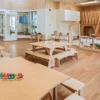
Thank you to all of you who recently entered our Natural Pod newsletter subscription contest! Subscribing to our newsletter gave you a chance to be entered to win a pair of our beautiful, new, sustainably made Natural Pod Stools. They are the classroom stool you’ve...
Across diverse contexts, I regularly meet students who are taking action to build a more sustainable future. Whether it’s first-graders designing a rain garden for their playground, middle schoolers educating adults about composting, or high school students advocating...
Diversity and inclusivity in learning environments is a topic that is at the heart of our work in creating empowering and multifunctional learning furniture inspired by educators and learners’ needs. This article is written by our inhouse Learning & Development...
That is how long a child spends in a classroom between kindergarten and graduation. That is 15,000 hours of breathing, touching, and existing in a space that tells them who they are and what they are worth. If you have ever stood in a learning environment and known in...
The physical environment fundamentally shapes human behavior, and in educational spaces, intentionally integrating biophilic design elements can positively influence student actions to drive better learning outcomes. While humans have an intrinsic need to connect with...
Designing a learning environment means making decisions for children you haven’t met yet, at ages they haven’t reached, in a room that will be used in ways you can’t fully anticipate. That weight is real — and educators carry it every time they...
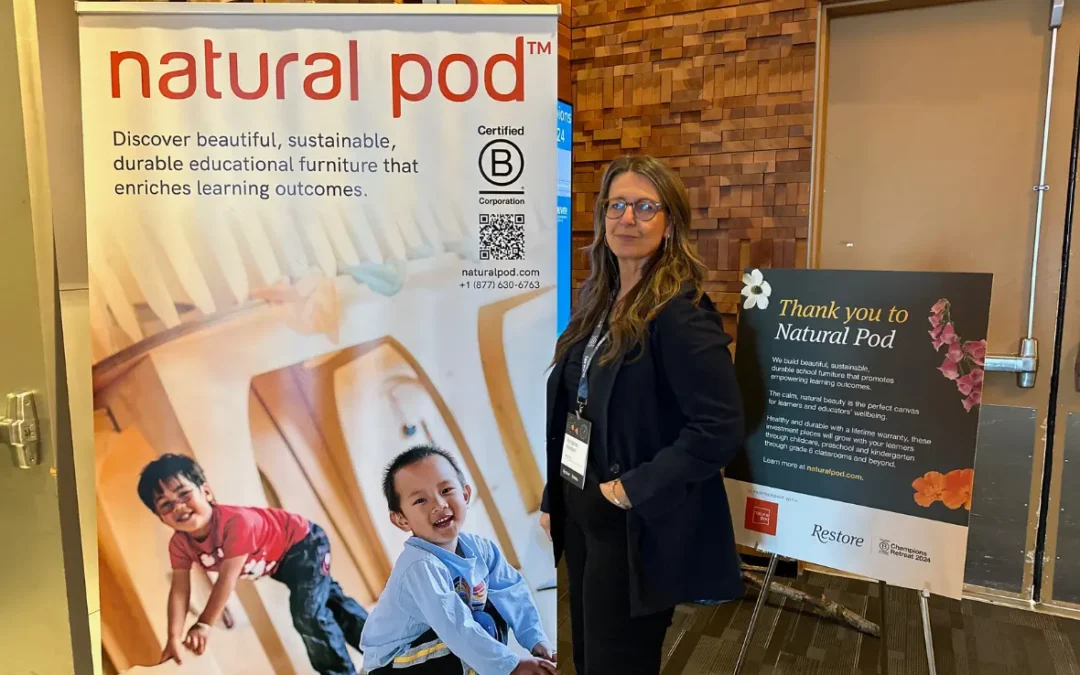
Designing for a Regenerative Future At Natural Pod, we believe that when we design spaces with care, we create the conditions for everyone to contribute their best work. This principle guides our presence at the 2026 B Corp Champions Retreat in Milwaukee, where we are...
Originally written by Michelle Carpenter. Updated by Natural Pod on March 30, 2026. A child walks into a classroom and within seconds, they start making sense of the space. The light. The colors. The level of visual noise on the walls. Before a single lesson begins,...
There is growing consensus among educators, neuroscientists, and child development researchers that the environments in which children learn matter as much as what they are being taught. Nowhere is this more evident — or more underutilized — than in early childhood...
Imagine a straight A student who can’t remember a single thing they learned when looking back on their school year. This is the silent crisis of the ‘stand and deliver’ model—an outdated method that prioritizes content delivery over the learning...